
Cost Implications and Processes of Creating Custom Molds for Unique Bottle Shapes
In the competitive landscape of beverage packaging and drinkware, brands are increasingly turning to custom bottle shapes to stand out, enhance brand identity, and deliver innovative products. However, creating custom molds for these unique designs involves nuanced cost considerations and a structured process. Let’s dive into the key factors and steps to bring your bespoke bottle vision to life, with insights tailored for businesses partnering with experts like Medo Drinkware.
Cost Implications of Custom Bottle Molds
Understanding the cost drivers is crucial for budgeting and decision-making. Here’s what influences the price of crafting a custom bottle mold:
- Mold Type & Manufacturing Method: The choice between injection molding (ideal for rigid, detailed bottles) or blow molding (common for hollow, lightweight containers) impacts costs. Injection molds, with their precision, often carry a higher upfront cost than simpler blow molds.
- Design Complexity: Intricate shapes, embossed logos, textured surfaces, or multi-component bottles (e.g., with integrated handles or caps) require more engineering, tooling time, and material, driving costs up. A sleek, minimalist design will be more budget-friendly than a bottle with complex undercuts or 3D details.
- Mold Material: Molds are typically made from steel (e.g., P20, H13) or aluminum. Steel molds, especially hardened grades like H13, offer durability for high-volume production but cost more upfront. Aluminum molds are cheaper and suitable for short runs or prototyping.
- Production Volume: While the initial mold cost is fixed, larger production runs reduce the per-unit cost of the bottle (as the mold cost is spread across more units). For small batches, consider if the branding impact justifies the higher unit cost, or explore temporary mold solutions (e.g., aluminum for trials).
- Post-Mold Adjustments: Even with careful planning, design tweaks or quality improvements may be needed post-production. Modifying a mold (e.g., adjusting wall thickness, refining a logo) adds cost, so thorough prototyping is key to minimize revisions.
Processes Involved in Custom Mold Creation
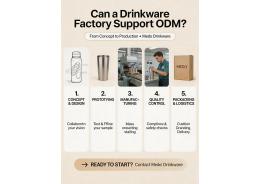
Creating a custom bottle mold is a collaborative, multi-stage journey. Here’s the typical workflow, from concept to production:
- Design & Collaboration:
Start with a detailed brief: share your brand’s vision, target audience, and functional requirements (e.g., leak-proof, stackable). The design team (like Medo Drinkware’s experts) will translate this into 2D sketches and 3D CAD models, incorporating feedback to finalize the design. This phase ensures the mold aligns with your aesthetic and practical goals (e.g., ergonomics, filling efficiency).
- Prototyping:
Before investing in a full mold, a physical prototype (via 3D printing, CNC machining, or handcrafting) is created. This allows you to:
- Visually and physically assess the bottle’s shape, size, and feel.
- Test functionality (e.g., screw-on caps, liquid retention).
- Make cost-effective design changes before mold production.
- Mold Manufacturing:
Once the prototype is approved, the mold is machined. This involves:
- CNC Machining: Precision-cutting the mold cavity and core from steel or aluminum.
- EDM (Electrical Discharge Machining): For complex internal details or hard-to-reach areas that CNC can’t handle.
- Assembly: Combining mold components (e.g., ejector pins, cooling channels) for smooth operation.
- Testing & Refinement:
Conduct a trial run (small-batch production) to test the mold. Check for:
- Uniform wall thickness (to avoid weak spots or warping).
- Accurate reproduction of logos, textures, and shapes.
- Consistency in bottle dimensions and quality.
- Mass Production:
With a validated mold, full-scale production begins. The mold is installed in production machinery (injection or blow molding machines), and bottles are produced at scale. Ongoing quality checks ensure the mold remains consistent over thousands (or millions) of units.
Tips for Optimizing Your Custom Mold Project
To balance cost and quality:
- Partner with a manufacturer (like Medo Drinkware) that offers end-to-end services—from design to production—for streamlined communication and cost efficiency.
- Prioritize “must-have” design elements (e.g., a signature curve) and simplify non-critical details to control complexity.
- For new brands or limited editions, start with a smaller production run using a temporary (aluminum) mold to test market response before investing in a high-cost steel mold.
Creating custom bottle molds is an investment in your brand’s uniqueness—but with clear cost awareness and a structured process, it’s a strategic move to differentiate in the market. Whether you’re launching a new beverage line or reimagining your drinkware, understanding these factors empowers you to make informed, cost-effective decisions.

 English
 German
 French
 Russian
 Spanish
 Japanese
 Korean
 Portuguese
 Ukrainian
 Arabic
 Italian


